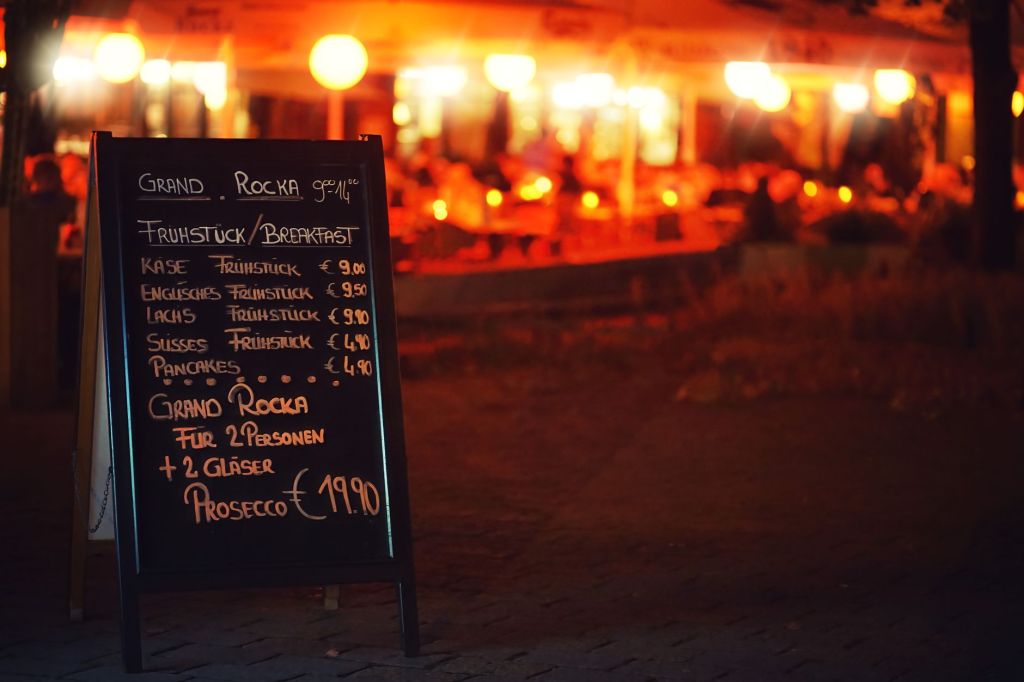
Researched 14 September 2026. The averages at the top are official statistics from the Korea Consumer Agency’s Chamgagyeok price survey. The restaurant tables that follow list only places rated 3.9 or higher (a threshold we set for this series). Ratings come from a single source, and some listings have single-digit review counts — so the review count is shown for every entry. Where we could not confirm a figure, we say “unconfirmed” rather than guess. Korean, Japanese and Chinese versions are also published.
What protects you from being overcharged is not a list of good restaurants. It is one number. Once you know what normal costs, there is nothing to negotiate.
Eight numbers worth memorising
These are Seoul averages from the Korea Consumer Agency’s monthly survey, as of July 2026.
| Item | Seoul average | Year on year |
|---|---|---|
| Gimbap (1 roll) | ₩3,869 | +6.8% |
| Jajangmyeon | ₩7,654 | +2.1% |
| Kimchi stew set meal | ₩8,654 | +0.9% |
| Kalguksu | ₩10,038 | +3.6% |
| Bibimbap | ₩11,769 | +2.0% |
| Naengmyeon | ₩12,692 | +2.2% |
| Samgyetang | ₩18,192 | +1.5% |
| Samgyeopsal (per 200 g) | ₩21,321 | +3.3% |
Kalguksu crossed ₩10,000 for the first time in March 2026. And gimbap rose the most.
These eight matter because they are the only figures a government body measures monthly using the same method. A single restaurant may have good reasons to be expensive. But more than double the average needs an explanation.
💡 How to use this table
Photograph the menu before you sit down and compare. Within 1.5× the average is normal — in a tourist area, that’s fair. More than double, walk to the next place.
One caveat: the Consumer Agency states that directly comparing prices between regions is not appropriate. Don’t apply Seoul figures elsewhere in Korea.
Fixed reference points — franchise list prices
Chicken and burgers have prices set by head office. These don’t move.
| Brand | Item | Price |
|---|---|---|
| BBQ | Golden Olive fried chicken, whole | ₩23,000 |
| BBQ | Golden Olive, seasoned | ₩24,500 |
| bhc | Fried chicken, whole | ₩22,000 |
| bhc | Bburinkle · Matchoking · Redking | ₩23,000 each |
| Kyochon | Honey Combo (in store / own app) | ₩23,000 |
| Kyochon | Honey Combo (delivery apps) | ₩25,000 |
| Brand | Item | Price | Effective |
|---|---|---|---|
| McDonald’s | Big Mac | ₩5,700 | 20 Feb 2026 |
| McDonald’s | Big Mac meal | ₩7,600 | 20 Feb 2026 |
| McDonald’s | Bulgogi Burger | ₩3,800 | 20 Feb 2026 |
| Burger King | Whopper | ₩7,400 | 12 Feb 2026 |
| Burger King | Whopper meal | ₩9,600 | Feb 2026 |
| Burger King | Whopper Jr. | ₩5,000 | 12 Feb 2026 |
Whole chicken ₩23,000. Big Mac ₩5,700. Whopper ₩7,400. Memorise those three and you can judge most situations.
⚠️ Delivery apps cost more — and that’s legal
Since 19 September 2025, more than 90% of Kyochon’s Seoul franchises charge ₩2,000 more on delivery apps. Jadam Chicken, bhc, McDonald’s, Lotteria, Burger King, Mom’s Touch and KFC also price delivery higher.
This is published dual pricing, not a scam. But it costs you if you don’t know. If your hotel is close, collecting in person is cheaper.
What each category actually costs
From here on these are real menu prices. Only places rated 3.9 or above, sorted most expensive to cheapest.
Fried chicken
| Name | District | Item | Price | Rating | Reviews |
|---|---|---|---|---|---|
| Gyeyeolsa | Jongno | Fried chicken | ₩24,000 | 4.1 | 80 |
| Isu Tongdak | Seocho | Fried chicken | ₩22,000 | 4.1 | 16 |
| Gyedong Chicken | Jongno | Whole chicken | ₩22,000 | 4.1 | 8 |
| Geoseong Hof | Jongno | Fried chicken | ₩21,000 | 4.0 | 3 |
| Chicken Cafe Mullae | Yeongdeungpo | Fried | ₩21,000 | 5.0 | 4 |
| 21C Hof Chicken | Gwanak | Fried | ₩20,000 | 3.9 | 7 |
| Yetnal Tongdak Baksa | Geumcheon | Fried | ₩19,000 | 5.0 | 1 |
| Cheorin 7-ho | Mapo | Crispy fried | ₩19,000 | 4.0 | 6 |
| Chicken in the Kitchen | Mapo | This is Not a Chicken | ₩18,500 | 4.1 | 6 |
| Oneul Tongdak Sinchon | Seodaemun | Wing & drumstick crispy | ₩16,900 | 4.3 | 8 |
| Goobne Chicken (Guro) | Guro | Goobne Original | ₩15,000 | 4.5 | 2 |
| Nangman Chicken Hof | Jungnang | Fried (dine-in) | ₩14,000 | 5.0 | 1 |
| Myeongga Yetnal Tongdak | Songpa | Onion cream chicken | ₩14,000 | 4.0 | 1 |
| Achasan Tongdak | Gwangjin | Old-style whole chicken | ₩5,000 | 4.5 | 3 |
High ₩24,000 / low ₩5,000 / average ₩17,957. Excluding the ₩5,000 outlier, the average is ₩18,954 and the normal band is ₩14,000–24,000.
Samgyeopsal — always check the grams
| Name | District | Item (grams) | Price | Per 100 g | Rating | Reviews |
|---|---|---|---|---|---|---|
| Urinara Samgyeopsal | Yeongdeungpo | Fresh pork belly 180 g | ₩19,000 | ₩10,556 | 4.0 | 1 |
| Yukjipteo | Mapo | Ilgui Samgyeopsal 150 g | ₩18,000 | ₩12,000 | 4.1 | 3 |
| Gopchang Paneun Gogijip | Mapo | Golden-ratio belly 160 g | ₩18,000 | ₩11,250 | 4.1 | 13 |
| Sotbap Samgyeopsal | Mapo | Dodram premium belly | ₩18,000 | unconfirmed | 4.0 | 3 |
| Gangnam Dwaeji Sanghoe | Gangnam | Pork platter, all you can eat | ₩17,900 | n/a | 4.2 | 31 |
| Gogikkun Kim Chunbae Gongdeok | Mapo | Pork belly 150 g | ₩17,000 | ₩11,333 | 4.3 | 5 |
| Pyohyeon Sikdang Seodaemun | Seodaemun | Thick-cut belly | ₩17,000 | unconfirmed | 3.9 | 2 |
| Hanam Dwaejijip Seokchon | Songpa | Pork belly 180 g | ₩16,000 | ₩8,889 | 4.3 | 4 |
| Wolhwa Sikdang Yeongdeungpo | Yeongdeungpo | Aged belly | ₩16,000 | unconfirmed | 4.7 | 3 |
| Sotdon Yeongdeungpo | Yeongdeungpo | Sot samgyeopsal | ₩16,000 | unconfirmed | 4.7 | 8 |
| Sangguné Sotttukkeong Junggok | Gwangjin | Dodram Korean pork (≈200 g) | ₩16,000 | ₩8,000 (est.) | 4.5 | 3 |
| Nowon Mokgogijip | Nowon | Pork neck 200 g | ₩15,000 | ₩7,500 | 4.4 | 8 |
High ₩19,000 / low ₩15,000 / average ₩16,992. The spread looks narrow — but per 100 g it runs from ₩7,500 to ₩12,000, a 1.6× difference.
⚠️ With samgyeopsal, the scam is the weight, not the price
“One portion, ₩17,000” looks the same everywhere. But 150 g and 200 g are not the same portion. Of the 12 places we checked, 4 did not state the weight at all.
Ask “how many grams?” before ordering. Hesitation is itself a signal.
For reference, the Seoul average is ₩21,321 per 200 g — about ₩10,660 per 100 g.
Korean beef — all Hanwoo
| Name | District | Item (grade, grams) | Price | Per 100 g | Rating | Reviews |
|---|---|---|---|---|---|---|
| Mingyu Samseong | Gangnam | 1++ Hanwoo standard course | ₩109,000 | n/a | 5.0 | 1 |
| Nowon Hanu | Nowon | Hanwoo striploin 220 g | ₩78,000 | ₩35,455 | 4.6 | 3 |
| Gouga Yeouido | Yeongdeungpo | 1++ charcoal-aged sirloin 130 g | ₩69,000 | ₩53,077 | 4.4 | 24 |
| Seoul Loin Seoul | Jung | 1++ mixed grill 130 g | ₩69,000 | ₩53,077 | 4.2 | 15 |
| Myeongin Deungsim (Sangam) | Mapo | 1++ BMS9 prime sirloin 130 g | ₩49,000 | ₩37,692 | 4.5 | 4 |
| Myeongin Deungsim Samseong | Gangnam | 1++ BMS9 prime sirloin | ₩49,000 | unconfirmed | 4.4 | 11 |
| Jeongdong 1946 City Hall | Jung | 1++ striploin 130 g | ₩45,000 | ₩34,615 | 4.7 | 5 |
| Seokswe | Songpa | Hanwoo outside skirt 100 g | ₩35,000 | ₩35,000 | 4.3 | 3 |
| Teolbo Butcher Restaurant | Gangbuk | Cow 1++ BMS9 brisket 200 g | ₩30,000 | ₩15,000 | 4.0 | 4 |
| Mungane Butcher Suyu | Gangbuk | Hanwoo brisket 150 g | ₩23,000 | ₩15,333 | 4.1 | 11 |
| Seomin Hanu | Gangseo | Hanwoo ribeye 100 g | ₩15,000 | ₩15,000 | 4.0 | 1 |
High ₩109,000 / low ₩15,000 / average ₩51,909. Excluding the course menu, ₩46,200.
Per 100 g the market splits cleanly in two. Butcher-style restaurants sit around ₩15,000; specialist grill and fine-dining places run ₩34,000–53,000. A three-fold gap — and it is all Hanwoo.
For reference, Hanwoo grade 1 sirloin costs about ₩15,031 per 100 g at retail (Korea Institute for Animal Products Quality Evaluation, July 2026). Butcher-style restaurants sell near cost and charge separately for the table; fine-dining prices include ageing, service and location.
Burgers (independent)
| Name | District | Item | Price | Rating | Reviews |
|---|---|---|---|---|---|
| Philly Philly Seongsu | Seongdong | Original Philly Cheese Steak | ₩12,000 | 5.0 | 1 |
| Jacoby’s Burger | Yongsan | Jacoby Burger | ₩11,900 | 4.3 | 29 |
| bd Burger Seongsu | Seongdong | Double Cheeseburger | ₩11,900 | 4.3 | 40 |
| Rocca Doodle Seongsu | Seongdong | Classic (chicken burger) | ₩11,800 | 4.7 | 8 |
| Downtowner Hannam | Yongsan | Downtowner | ₩10,300 | 4.5 | 108 |
| Knees Burger Yeouido | Yeongdeungpo | Knees Burger | ₩8,900 | 4.4 | 4 |
| Burger Snack | Yongsan | Cheeseburger | ₩8,000 | 5.0 | 2 |
| The Real Cheese Burger Itaewon | Yongsan | Original | ₩7,900 | 4.0 | 3 |
| Bath Burger | Yeongdeungpo | Bath Burger | ₩7,800 | 4.3 | 43 |
| Space One Burger | Mapo | Cheeseburger | ₩7,800 | 4.4 | 7 |
| Butter Burger | Gwangjin | Cheese Burger | ₩7,800 | 4.3 | 13 |
| Beok Beok | Yongsan | Beok Beok | ₩7,400 | 4.3 | 14 |
| Seven Patty Burger Euljiro | Jung | Classic Cheese | ₩6,900 | 4.7 | 3 |
| Burger Go | Nowon | Burger Go | ₩6,500 | 5.0 | 2 |
High ₩12,000 / low ₩6,500 / average ₩9,064. Of the 14 places checked, not one charged over ₩13,000 for a basic burger.
Tteokbokki
| Name | District | Item | Price | Portion | Rating | Reviews |
|---|---|---|---|---|---|---|
| Tteokbokki Sanghoe | Mapo | Glass-noodle tteokbokki | ₩20,000 | not stated | 4.3 | 10 |
| Ttitto Bunsik | Seongdong | Soupy tteokbokki | ₩9,800 | not stated | 4.2 | 17 |
| Orak | Yeongdeungpo | Instant tteokbokki | ₩8,000 | 1 portion | 4.5 | 9 |
| Ruby Tteokbokki | Gangnam | Ruby tteokbokki | ₩6,000 | 1 portion | 4.0 | 21 |
| Dal Tteokbokki | Yangcheon | Chewy rice-cake tteokbokki | ₩6,000 | 1 portion | 4.5 | 2 |
| Sintobuli Tteokbokki | Gwangjin | Tteokbokki | ₩5,000 | 1 portion | 4.1 | 138 |
| Himnaera Tteoktwisun | Jung | Tteokbokki | ₩5,000 | 1 portion | 4.4 | 3 |
| Kkokji Tteokbokki | Dongjak | Rice-cake tteokbokki | ₩4,500 | not stated | 4.4 | 2 |
| Chamtteok & Kimtteok | Yeongdeungpo | Tteokbokki | ₩4,500 | 1 portion | 4.7 | 5 |
| Matjjang Tteokbokki | Gangnam | Tteokbokki | ₩4,000 | not stated | 4.6 | 8 |
| Masitneunjip | Seodaemun | Tteokbokki | ₩4,000 | 1 portion | 4.7 | 18 |
| Sinheung Tteokbokki | Seodaemun | Tteokbokki | ₩4,000 | not stated | 4.2 | 13 |
| Mapo Wonjo Tteokbokki | Mapo | Tteokbokki (cash only) | ₩3,500 | 1 portion | 4.0 | 68 |
| 7-beonga Bunsik | Mapo | Tteokbokki | ₩3,500 | not stated | 5.0 | 1 |
Counting only the 8 places that stated a portion size: high ₩8,000 / low ₩3,500 / average ₩5,250. That is the real per-portion figure. Ignore the all-in average of ₩6,271 — it is inflated by items whose portion size is unclear.
A neighbourhood snack bar charges ₩4,000–5,000 per portion. If a tourist area quotes three times that, check the quantity.
Shabu-shabu
| Name | District | Item | Price | Basis | Rating | Reviews |
|---|---|---|---|---|---|---|
| Meri King Seoul North | Seongbuk | 2++ Hanwoo all-you-can-eat (eve / weekend) | ₩43,000 | per person | 4.4 | 7 |
| Shabu in Seoul Seongsu | Seongdong | Black Nine wagyu ribeye set (dinner) | ₩37,000 | per person | 4.9 | 17 |
| Shabu in Seoul Sinyongsan | Yongsan | Black Nine wagyu ribeye set | ₩36,000 | per person | 4.5 | 28 |
| Shabu All Day Imun | Dongdaemun | Weekend unlimited meat | ₩31,800 | per person | 4.4 | 3 |
| Shabu All Day Jayang | Gwangjin | Weekday evening unlimited meat | ₩30,800 | per person | 4.4 | 7 |
| Shabu All Day Sinnae | Jungnang | Weekday evening unlimited meat | ₩30,800 | per person | 4.9 | 4 |
| Shabu Mall Sadang | Dongjak | Dinner steamed shabu, unlimited | ₩25,900 | per person | 4.8 | 9 |
| Bomdama Bangbae | Seocho | Weekday dinner, adult | ₩17,900 | per person | 4.6 | 2 |
| Shabo Shabo | Seongdong | Shabu-shabu course | ₩14,900 | per person | 4.5 | 2 |
| Shabu-ro 21 | Dongjak | Single-serve shabu | ₩8,000 | per person | 4.7 | 29 |
High ₩43,000 / low ₩8,000 / average ₩27,610. All ten places we confirmed price per person.
💡 Lunch is often close to half price. The same Meri King charges ₩18,500 at weekday lunch against ₩43,000 in the evening.
Jeon and makgeolli
| Name | District | Assorted jeon platter | Makgeolli (bottle) | Rating | Reviews |
|---|---|---|---|---|---|
| Daebanjeon Sadang | Dongjak | ₩38,000 (unlimited, up to 3 people) | unconfirmed | 4.2 | 7 |
| Jeonju Jeonjip | Dongjak | ₩32,000 | unconfirmed | 4.0 | 50 |
| Kim Satgat Pajeon | Dongjak | ₩30,000 | unconfirmed | 4.8 | 4 |
| Jeonsarang | Seocho | ₩29,000 (9 kinds, 24 pieces) | from about ₩6,000 | 4.3 | 7 |
| Dongnae Modumjeon | Dongjak | ₩29,000 | ₩6,000–20,000 | 4.4 | 4 |
| Sadang Kkul Jeonjip | Dongjak | ₩29,000 | ₩6,000 | 4.0 | 1 |
| Hanil Jeon | Seongbuk | ₩28,000 | unconfirmed | 4.4 | 2 |
| Namdo Jeonjip | Dongjak | ₩27,000 | ₩4,000–20,000 | 4.0 | 1 |
| Chogamaeul Gangnam | Gangnam | ₩26,000 (7 kinds) | ₩6,500–9,500 | 5.0 | 2 |
| Jeongganne Jijimi | Seongbuk | ₩25,000 | unconfirmed | 5.0 | 2 |
| Jeonjip Gaja | Gangnam | ₩25,000 | unconfirmed | 4.0 | 1 |
| Wolmaene Jumak | Seocho | ₩24,000 | dongdongju ₩9,500 | 3.9 | 5 |
| Mirim Jeonjip | Seongbuk | large ₩17,000 / medium ₩10,000 | unconfirmed | 4.0 | 1 |
Platter: high ₩38,000 / low ₩17,000 / average ₩27,615.
Only 5 of 13 places stated a per-bottle makgeolli price. The floor is ₩4,000; premium bottles run ₩9,000–25,000. For reference, Seoul Jangsu makgeolli is about ₩4,000 in restaurants and Jipyeong about ₩4,500.
⚠️ With a jeon platter, the count is the price
The controversy started when a ₩15,000 platter at Gwangjang Market turned out to hold about ten pieces. The ₩29,000 platter above states “9 kinds, 24 pieces.”
If the count isn’t on the menu, ask before ordering.
Chinese-Korean restaurants
| Name | District | Jajangmyeon | Jjamppong | Sweet & sour pork (small) | All three | Rating | Reviews |
|---|---|---|---|---|---|---|---|
| Chunbalwon | Jung | ₩7,000 | ₩8,000 | ₩25,000 | ₩40,000 | 5.0 | 2 |
| Dorim 186 | Yeongdeungpo | ₩7,000 | ₩10,000 | ₩23,000 | ₩40,000 | 4.2 | 10 |
| Donghwajang | Gwangjin | ₩8,000 | ₩9,000 | ₩22,000 | ₩39,000 | 4.3 | 4 |
| Choegoseong | Dobong | ₩8,000 | ₩9,000 | ₩22,000 | ₩39,000 | 5.0 | 1 |
| Geumyonggak | Gwangjin | ₩8,000 | ₩9,000 | ₩22,000 | ₩39,000 | 4.0 | 1 |
| Chaerin | Gwangjin | ₩8,000 | ₩9,000 | ₩20,000 | ₩37,000 | 4.5 | 6 |
| Achaseong | Gwangjin | ₩7,500 | ₩9,000 | ₩20,000 | ₩36,500 | 4.4 | 6 |
| Junghwa Yori Dongudang | Seongbuk | ₩7,000 | ₩8,500 | ₩20,000 | ₩35,500 | 5.0 | 1 |
| Donghaeru | Seongdong | ₩6,000 | ₩7,000 | ₩22,000 | ₩35,000 | 4.1 | 4 |
| Haenam Jjamppong Gunja | Gwangjin | unconfirmed | ₩12,000 | single-serve ₩9,000 | — | 4.5 | 7 |
| Gangnam | Yeongdeungpo | unconfirmed | ₩9,000 | medium ₩22,000–24,000 | — | 4.2 | 25 |
| Jungguk-gwan | Gwangjin | ₩4,000 (designated fair-price shop) | ₩5,000 | unconfirmed | — | 5.0 | 1 |
Jajangmyeon average ₩7,050 (almost identical to the Seoul official average of ₩7,654), jjamppong ₩8,708, sweet & sour pork (small) ₩20,500.
All three together comes to ₩35,000–40,000. Far outside that range, read the menu again.
Raw fish — the riskiest category
| Name | District | Item | Price | Basis | Rating | Reviews |
|---|---|---|---|---|---|---|
| Mukhojip | Jung | Manager’s sashimi | ₩220,000 | not stated | 4.2 | 3 |
| Jungnim-dong Mulgogi | Jung | Premium sashimi course | ₩85,000 | 1 person | 3.9 | 2 |
| Eodo Hoetjip | Seodaemun | Flatfish + rockfish | ₩85,000 | 4 people | 4.0 | 1 |
| Makssseori Hoe Seodaemun | Jongno | Makssseori sashimi | ₩80,000 | 3 people | 4.7 | 3 |
| Misiryeong Neomeo | Jung | 4-person set | ₩78,000 | 4 people | 4.2 | 3 |
| Maknae Hoetjip | Jung | Flatfish + rockfish (large) | ₩70,000 | large (≈2) | 4.2 | 29 |
| Maknaene Hoejip | Jung | Flatfish & rockfish | ₩70,000 | not stated | 4.2 | 2 |
| Hyundai Susan | Seodaemun | After-8pm sashimi | ₩70,000 | 4 people | 4.4 | 9 |
| Yeongdeok Makhoe | Seodaemun | Makhoe | ₩65,000 | 4 people | 5.0 | 3 |
| Pohangjip | Jung | Aged sashimi platter | ₩60,000 | not stated | 4.0 | 2 |
| Neolbeokji Hoetjip | Seodaemun | Flatfish sashimi | ₩60,000 | not stated | 4.0 | 1 |
| Daechan Hoetjip | Jongno | Red seabream (small) | ₩50,000 | small | 4.2 | 17 |
| Yeongdeok Mulhoe Makhoe | Jung | Mixed makhoe (large) | ₩48,000 | large | 5.0 | 1 |
| Busan Hoetjip | Yongsan | Sashimi set | ₩40,000 | not stated | 4.5 | 1 |
| Seoneodo Chungjeongno | Seodaemun | Sashimi | ₩30,000 | 1 person | 4.0 | 1 |
High ₩220,000 / low ₩30,000 / average ₩74,067 / median ₩70,000.
The average is not the point. Of the 15 places checked, not one wrote “market price” on the menu. But 8 did not state how many people the dish serves. Even the ₩220,000 item doesn’t say.
“Market price” has disappeared — and “no portion stated” has taken its place.
⚠️ How to judge a sashimi price — the wholesale benchmark
As of August 2026, farm-gate flatfish is ₩22,800 per kg (Noryangjin), and the consumer price compiled by the Ministry of Oceans and Fisheries is ₩37,950 per kg. Rockfish is ₩37,430 per kg. At a supermarket, 300 g of flatfish sashimi costs ₩23,000–26,000.
So 1 kg of raw fish costs a consumer about ₩38,000. Filleting cuts the weight by more than half, and a restaurant also sells you the table, the side dishes and the service — so two to three times that is normal.
The problem is when you don’t know how many people it feeds. Before ordering, ask “for how many people?” and “is this the final price?”
Japanese food — count the pieces
| Name | District | Item | Price | Pieces | Rating | Reviews |
|---|---|---|---|---|---|---|
| Momoyama | Jung | Omakase course | ₩340,000 | not stated | 4.3 | 5 |
| Sushi Mito | Jung | Special omakase | ₩180,000 | not stated | 5.0 | 1 |
| Sushi Cho | Jung | Lunch (hall) | ₩170,000–225,000 | not stated | 4.4 | 17 |
| Sushi Hwajeong | Jung | Star omakase | ₩140,000 | 12 sashimi + 7 sushi | 4.0 | 1 |
| Bae Susa | Jung | Premium tuna (1 person) | ₩120,000 | sashimi | 4.0 | 1 |
| Kim Susa Shinsegae Main | Jung | Kim Susa sashimi | ₩100,000 | sashimi | 4.6 | 4 |
| Jingawa | Jung | Chef’s special course (2+) | ₩88,000 | not stated | 4.1 | 10 |
| Hananomai | Jung | Premium sashimi course | ₩60,000 | not stated | 4.4 | 5 |
| Mijin Ilsik | Jung | Assorted sashimi course | ₩60,000 | sashimi | 4.2 | 7 |
| Sushi Charim | Yongsan | Blue Ribbon set | ₩52,000 | 30 pcs | 4.2 | 7 |
| Seongwon Ilsik | Jung | Sashimi set | ₩40,000 | sashimi | 4.1 | 4 |
| Kkokkiri Chobap | Jongno | Kkokkiri Sushi C | ₩38,000 | 14 pcs | 4.3 | 9 |
| Osai Chobap Gwanghwamun | Jongno | Dinner omakase | ₩33,000 | 12 sushi + sides | 4.8 | 8 |
| Eunhaenggol City Hall | Jung | Doro set sushi | ₩29,000 | 12 pcs | 4.4 | 5 |
| Seohae Chobap Seoul Stn | Yongsan | Seohae sushi | ₩22,000 | 15 pcs + sides | 4.5 | 4 |
High ₩340,000 / low ₩22,000 / average ₩98,133 / median ₩60,000. A textbook case where the average tells you nothing.
Use the per-piece figure instead.
| Item | Price | Pieces | Per piece |
|---|---|---|---|
| Kim Susa takeaway sushi | ₩40,000 | 14 | ₩2,857 |
| Kkokkiri Sushi C | ₩38,000 | 14 | ₩2,714 |
| Eunhaenggol Doro set | ₩29,000 | 12 | ₩2,417 |
| Sushi Charim signature | ₩28,000 | 14 | ₩2,000 |
| Kkokkiri Sushi A | ₩19,000 | 10 | ₩1,900 |
| Sushi Charim Blue Ribbon | ₩52,000 | 30 | ₩1,733 |
| Seohae sushi | ₩22,000 | 15 | ₩1,467 |
| Eunhaenggol premium sushi | ₩17,000 | 12 | ₩1,417 |
₩1,400–2,900 per piece is the normal range. Conveyor-belt sushi runs ₩1,500–8,000 per plate (2 pieces per plate).
Of the 7 omakase restaurants, only 2 published the number of pieces. ₩22,000 and ₩340,000 carry the same word on the sign.
Malatang — the per-100 g rate is everything
| Name | District | Per 100 g | Rating | Reviews |
|---|---|---|---|---|
| Mara-ui Sin | Songpa | ₩3,225 (400 g for ₩12,900) | 4.6 | 4 |
| Mara Gongbang Jamsil Stn | Songpa | ₩2,200 | 4.1 | 6 |
| Mara Gongbang Lotte World | Songpa | ₩2,200 | 3.9 | 9 |
| Chunli Malatang Songpa | Songpa | ₩2,200 | 4.4 | 4 |
| Wangfujing Malatang Garden5 | Songpa | ₩2,200 | 5.0 | 1 |
| Sin Mara Myeongga Songpa | Songpa | ₩2,150 (600 g for ₩12,900) | 5.0 | 1 |
| Xiangchi Mara Jamsil | Songpa | ₩2,100 | 5.0 | 2 |
| Shaotangjia Malatang | Songpa | ₩1,900 | 4.4 | 4 |
| Mara Gongbang Munjeong | Songpa | ₩1,900 | 4.0 | 8 |
| Xinlongfu Malatang Suseo | Gangnam | ₩1,900 | 4.0 | 2 |
| Cheonmi Malatang | Songpa | ₩1,900 | 5.0 | 1 |
High ₩3,225 / low ₩1,900 / average ₩2,170 / median ₩2,150 per 100 g. Highest to lowest is only 1.7×. Malatang is the category where overcharging is nearly impossible — if you know the rate.
A portion is typically 400–600 g. At the average rate, 500 g comes to about ₩10,850.
⚠️ Some shops won’t tell you the weight
Of the 14 places checked, 3 sell only “one portion, ₩X” without publishing a weight (₩10,900 / ₩14,900 / ₩6,500). In malatang, that is the equivalent of “market price.” There is no way to tell whether it is expensive.
And the same brand differs by branch. Mara Gongbang charges ₩2,200 at Jamsil Station and Lotte World, ₩1,900 at Munjeong. A 16% difference.
Are tourist districts actually more expensive? We measured
The first version of this article had no sample from the main tourist districts. So we went back and surveyed 36 restaurants in the same categories across Myeongdong, Insadong, Itaewon and Namdaemun Market. The result was not what we expected.
Sit-down restaurants are barely different
| Category | Tourist district | Seoul-wide | Ratio | Sample |
|---|---|---|---|---|
| Samgyeopsal, per portion | ₩17,636 | ₩16,992 | 1.04× | 11 |
| Samgyeopsal, per 100 g | ₩11,855 | ₩7,500–12,000 | top of the band (1.22× the midpoint) | 6 |
| Hanwoo sirloin, per 100 g | ₩35,833 | ₩15,000–53,000 | 1.05× the midpoint | 4 |
| Tteokbokki, per portion | ₩4,600 | ₩5,250 | 0.88× | 5 |
| Jajangmyeon | ₩7,300 | ₩7,050 | 1.04× | 5 |
| Jjamppong | ₩8,000 | ₩8,708 | 0.92× | 3 |
| Sweet & sour pork (small) | ₩19,333 | ₩20,500 | 0.94× | 3 |
| Assorted sashimi (medium) | ₩43,000 | ₩50,545 | 0.85× | 3 |
| Assorted jeon platter | ₩24,000 | ₩27,615 | 0.87× | 3 |
| Fried chicken, whole | — | ₩17,957 | too few (2) | — |
| Sushi, per piece | — | ₩1,400–2,900 | could not calculate | — |
Of eleven measurements, only one exceeded 1.1× — samgyeopsal by weight. Tteokbokki, sashimi, jeon, jjamppong and sweet & sour pork were cheaper in the tourist districts.
⚠️ Don’t lean too hard on this table
Jjamppong, sweet & sour pork, sashimi and jeon rest on just 3 restaurants each. One different entry moves the number.
The 36 are also unevenly spread — Myeongdong 12, Namdaemun 11, Insadong 7, Itaewon 6. Myeongdong and Namdaemun effectively set the average. Namdaemun Market is a tourist site and a market-workers’ canteen district at the same time, which may hold prices down — but that is an untested guess.
Sushi could not be calculated at all, because both qualifying restaurants failed to state the number of pieces.
The gap is at the street stalls
The difference isn’t in restaurants with tables. It’s in the food you eat standing up.
Here are Myeongdong stalls against Namdaemun Market stalls, a ten-minute walk apart, same items (measured by Segye Ilbo, January 2024).
| Item | Myeongdong | Namdaemun Market | Ratio |
|---|---|---|---|
| Fish cake skewer | ₩2,000 each | ₩1,000 each | 2.0× |
| Mini gimbap | 6 rolls for ₩6,000 (₩1,000 each) | 5 rolls for ₩3,000 (₩600 each) | 1.67× |
| Chicken skewer | ₩5,000 | ₩3,000 | 1.67× |
| Grilled squid | ₩12,000 | around ₩10,000 | 1.2× |
Bungeoppang (fish-shaped pastry) spreads further (Herald Economy, December 2023).
| Where | Price | Per piece |
|---|---|---|
| Myeongdong | 3 for ₩4,000 | ₩1,333 |
| Seoul standard | 3 for ₩2,000 | ₩667 |
| Hoegi-dong, Dongdaemun | 5 for ₩1,000 | ₩200 |
Myeongdong is 2× the Seoul standard and 6.7× Hoegi-dong. Tanghulu was similar — ₩5,000 in Myeongdong against ₩3,000–4,000 elsewhere, 1.25–1.67× (June 2024).
⚠️ Those stall figures are from 2023–2024
We could not find any reporting on Myeongdong stall prices by item for 2025 or 2026. So we cannot tell you today’s ratio. The direction holds; don’t quote the numbers as current.
For context, Myeongdong’s named-vendor system has been in force since 2016, and the road-use fee is about ₩825,000 per stall per year (2021 figure). So “it’s expensive because of the pitch fee” is not supported by the numbers.
And tourist districts state the unit less often
This is the real finding.
| Category | Tourist district, no unit stated | Seoul-wide |
|---|---|---|
| Samgyeopsal grams | 5 of 11 (45%) | 4 of 12 (33%) |
| Hanwoo grams | 5 of 9 (56%) | — |
| Sashimi portions | 2 of 3 (67%) | 8 of 15 (53%) |
| Sushi piece count | 2 of 2 (100%) | omakase 5 of 7 |
| Jeon piece count | 2 of 3 (67%) | mostly unstated |
| Tteokbokki portions | 3 of 5 (60%) | — |
Prices match the rest of Seoul. Only the rate of stating the unit is consistently worse.
What that hides shows up directly in the sample.
- Jeon platters: the same “assorted jeon” ran ₩15,000 at one place and ₩33,000 at another — 2.2× apart — and neither stated the count. Exactly one restaurant did (11 kinds, ₩24,000).
- Hanwoo: the worst rate at 56%, and the highest unit prices, so the money at stake is largest. “Aged Hanwoo sirloin ₩63,000” means ₩42,000 or ₩63,000 per 100 g depending on whether it’s 150 g or 100 g.
- Samgyeopsal: even among the 6 that stated grams, the per-100 g price ranged from ₩10,588 to ₩14,000 — a 32% spread. Where it isn’t stated, you can’t run that check at all.
💡 So the conclusion changes
It is not “avoid tourist districts.” For a sit-down meal, Myeongdong costs about what your neighbourhood costs.
It is “in tourist districts, ask about the unit more carefully.” What’s missing there isn’t a fair price — it’s the grams, the count, the number of pieces. And street food is a different matter — stalls really do run up to twice the price.
The real trap is the unit
One thing repeats through all of this. The problem isn’t the price. It’s the unit.
| Category | Always ask |
|---|---|
| Samgyeopsal, beef | How many grams? |
| Tteokbokki, shabu-shabu | How many portions? |
| Jeon platter | How many pieces? |
| Raw fish | For how many people? Is this the final price? |
| Sushi | How many pieces? |
| Malatang | What’s the rate per 100 g? |
| Chicken, burgers | Is this the in-store price or the delivery price? |
A menu that lists a price without a unit is the warning sign. Honest places state the grams and the count first.
Measured figures from Gwangjang Market (reported November 2023):
| Item | Price | Actual quantity | Unit price |
|---|---|---|---|
| Sundae, 1 portion | ₩7,000 | 10 pieces | ₩700 each |
| Tteokbokki | ₩3,000 | 6 rice cakes | ₩500 each |
| Fish cake skewer | ₩3,000 | 2 skewers | ₩1,500 each |
| Oysters | ₩20,000 | 7 oysters | ~₩3,000 each |
| Assorted jeon | ₩15,000 | about 10 pieces | — |
In November 2025, a video showing ₩10,000 charged for sundae listed at ₩8,000 drew 4 million views. A 25% overcharge.
Not posting prices is itself a violation
Restaurants are required to display prices. Seoul inspects compliance across 51 business categories, and violations carry fines.
Measures underway as announced by Seoul in May 2026:
- Focused inspection of Gwangjang Market (May–June) — mystery shoppers monitoring conduct toward foreign customers
- Named-vendor system for street stalls (from June) — demerit points escalate to suspension and revocation of the road-use permit
- Price display compliance checks across 51 categories
- Quantity labelling in force since the first half of 2024
Penalties got heavier in 2026
A restaurant or lodging that fails to display prices, or charges above the displayed price, now faces a 5-day suspension on the first offence (in force from 2026). Previously a warning or corrective order came first.
Cases keep surfacing.
- November 2025, Gwangjang Market — yukhoe at ₩21,000, a live octopus dish at ₩35,000 (₩14,000 more than what was ordered), and sundae listed at ₩8,000 billed at ₩10,000 after meat was added without asking. Three accounts from Japanese and Chinese visitors were reported.
- April 2026, Gwangjang Market — ₩2,000 charged separately for a 500 ml bottle of water with no label. The visitors were from Myanmar and Russia. The correct price was not reported, so how large the overcharge was is unknown.
Tourist complaints keep rising. 902 in 2023 → 1,543 in 2024 → 1,744 in 2025, and 1,753 in the first seven months of 2026 alone — already past the whole of the previous year. 84.3% of complainants are foreign visitors.
⚠️ But restaurants do not appear in the top complaint categories
For January–July 2026 the ranking was: general lodging 500, shopping 376, airports and airlines 186, taxis 182, hotels 146. We could not find an annual figure for restaurants in any report.
So “restaurant complaints are surging” is not supported. This article does not claim it.
How to report
As officially announced by Seoul in February 2026:
| Situation | Contact | Number |
|---|---|---|
| Any tourism complaint | KTO tourist complaint line | 1330 (7 languages, daily 07:00–24:00) |
| Something that happened in Seoul | Seoul Dasan Call Center | 120 (5 languages, weekdays 09:00–18:00) |
| Online | Korea Tourism Organization website | — |
The list of reportable issues explicitly includes “price differs from the displayed price” and “no price list posted.”
You need evidence. Keep the receipt, a photo of the menu, the date and time, and the business name. Photographing the menu is the single most reliable defence you have.
What this article is and isn’t
The eight averages at the top are government statistics — use them as they are. The franchise prices too.
The restaurant tables are a different kind of thing.
- Ratings come from one source only. We excluded Naver from this research, and could not access Kakao Map, Siksin or CatchTable.
- Several listings have one or two reviews. A 5.0 rating there means nothing statistically. That is why the review count is shown for every entry.
- The sample is geographically skewed. 13 of 14 malatang shops are in Songpa; the Chinese restaurants cluster in Gwangjin, the jeon houses in Dongjak and Seongbuk, and the sashimi and sushi places in Jung and Jongno. This does not represent Seoul as a whole.
- The tourist districts were added later, as a separate survey of 36 restaurants. That sample is uneven too — Myeongdong 12, Namdaemun 11, Insadong 7, Itaewon 6 — and some categories rest on just 3 places. Do not trust those ratios to the decimal.
- We aimed for 15 places per category; we managed 10–15. We did not pad the lists.
These tables are not a ranking of Seoul’s best restaurants. They are a sample showing where normal prices sit. Use them for that and nothing else.
What we could not confirm
- Myeongdong stall prices by item for 2025–2026 — our stall ratios rest on 2023–2024 reporting, so we cannot state today’s figure
- Annual counts of restaurant-related tourist complaints — restaurants do not appear in the published top categories at all, so we could not find the number
- Any press reporting on food prices in Insadong, Itaewon or Bukchon — we found none. The only Seoul tourist areas with published price figures are Myeongdong and Gwangjang Market
- The correct price in the April 2026 Gwangjang Market water case — it was not reported, so no ratio can be calculated
- The start date and labelling unit of the Gwangjang Market quantity scheme
- A current Seoul average for tteokbokki — the figure we found (₩9,802) dates from October 2024
- Tonkatsu specialist prices — no restaurant had both a rating and a price
- Imported beef restaurants — likewise none, so we could not build a Hanwoo-versus-imported comparison
- Weights at 4 of the samgyeopsal restaurants — not on the menu
- Current official price lists for bhc, Goobne, Lotteria and Mom’s Touch
- Official per-100 g rates from malatang franchise head offices
In short
Three things.
One. Memorise three numbers. Jajangmyeon ₩7,654, whole fried chicken ₩23,000, Big Mac ₩5,700. Those are your baselines.
Two. Ask about the unit, not the price. How many grams, how many portions, how many pieces, how many per plate. Honest places write it down first.
Three. Photograph the menu. One photo makes a report possible — and usually, taking it prevents the problem.
Korean, Japanese and Chinese versions are also published. Busan, Incheon, Gwangju and Daejeon are coming. Seoul transport fares and taxi scams are covered in the companion article.
Tags
Korea travel, Seoul food prices, rip off, tourist scam, overcharging, Korea Consumer Agency, price display, fried chicken price, samgyeopsal, hanwoo, tteokbokki, shabu shabu, jeon, jajangmyeon, sashimi price, sushi price, malatang, Gwangjang Market, Myeongdong, 1330, Dasan 120, tourist complaint, delivery app pricing, Seoul restaurants, travel tips
Sources
- Korea Consumer Agency — Chamgagyeok dining prices
- Korea Fair Trade Commission — Consumer24
- Seoul Metropolitan Government — price stability and display rules
- Korea Institute for Animal Products Quality Evaluation
- Ministry of Oceans and Fisheries · Noryangjin market prices
- Diningcode
- Korea Tourism Organization 1330
 triproute37.com